
In K-8 science classrooms, physical prototypes are used more than analytical models to support learning (National Academies of Sciences, Engineering, and Medicine [NASEM], 2020; Purzer et al., 2022). This phenomenon arises from the fact that younger learners can quickly create physical prototypes, easily identify errors in their work, and are still developing the knowledge necessary to manipulate and create analytical models (Advancing Excellence in P-12 Engineering Education & American Society for Engineering Education, 2020; NASEM). The leading method for engineering physical prototypes in K-8 science classrooms is the build-and-test engineering strategy, which involves a prescribed design problem with stated prototype requirements and constraints for the intended solution, using inexpensive materials (Purzer et al.). However, drawbacks exist to the build-and-test strategy. According to Malkiewich and Chase (2019), students and teachers may focus overly on the construction of the prototype, rather than using the learned disciplinary content (i.e., science) to inform its creation.
In my previous experience using a district engineering-infused science curriculum with fifth-grade students, they concentrated on the building aspect of engineering. I believed that sixth-grade students would encounter similar challenges when applying grade-level science concepts to engineering prototyping. The purpose of this paper is to highlight reverse engineering as a method for supporting sixth-grade students in a middle school setting in learning the underlying scientific concepts involved in rapid prototyping activities that are integrated into engineering-infused science curricula.
The first aim of the project was to develop a method that emphasizes the connections between a rapid prototype and its scientific concepts while remaining as accurate as possible to the benchmark model. In this paper, benchmark models are mass-produced products that serve as references for rapid prototypes, in this instance, a metal thermos. The district science curriculum used was the OpenSciEd Thermal Energy (Mohan et al., 2022) unit. This engineering-infused science unit focused on having students determine why and how containers keep liquids hot or cold (Mohan et al.). During a brainstorming activity on the unit’s focus, the sixth-grade students listed a thermos as an object, and the engineering design challenge in the unit was to design a cup. The rapid-prototype benchmark for a thermos was integrated into the science unit, as students were already familiar with how it worked.
Rapid Prototyping in the Engineering Design Process
The engineering-infused science curriculum engages students in each stage of the engineering design process; this analysis prioritizes the prototyping stage. In the prototyping stage of the engineering design process, there are three levels of prototype fidelity. The fidelity levels are low (e.g., sketches), mid (e.g., functional but not complex products), and high (e.g., complex, and near-final ready products). Techniques in prototyping transform visual concepts, such as sketches, into functional products that, while not overly complex, are assessed, evaluated, and refined. Low- and mid-levels of prototyping fidelity are used in K-8 settings to create physical objects called rapid prototypes, constructed from affordable materials, such as cardboard, plastic, wood, tape, and glue. An example of a rapid prototype is a super-insulated cup made from inexpensive materials commonly found in the fast-food industry or grocery stores. The precision of the dimensions and proportions of the constructed insulated cup, crafted from inexpensive materials, is evaluated and improved within a brief period, typically a few hours or days. This quick assessment period enables evaluation of the rapid prototype’s performance concerning its underlying design concepts based on scientific and mathematical principles (Purzer et al., 2022). The results of the underlying scientific and mathematical concept checks inform necessary improvements, the generation of additional prototype ideas, and/or the exploration of new ideas.
In the case of the selected benchmark model, a thermos, the rapid prototype object, the disciplinary concepts are not insignificant but rather consequential. It is essential to link the scientific concepts of conduction, convection, and radiation, the focus of the science unit, to the characteristics of physical materials of the rapid prototype. An emerging engineering pedagogical strategy is reverse engineering to enhance the educational objectives of linking connected disciplinary knowledge of science and engineering design at the pre-college level (Ladachart et al., 2022; Purzer et al., 2022; Zhong et al., 2024). The process of disassembling a thermos into its fundamental components is reverse engineering. The effectiveness of the rapid prototype depends on the proper integration of science, physical materials, and design concepts.
One way to perform reverse engineering is to use the internet. The information for the thermos parts in Table 1 was compiled by examining images returned from a Google search using the phrase “thermos deconstructed view.” The parts of a thermos in Table 1 were created by aligning the science definitions of convection, radiation, and conduction with the thermos parts. The descriptions and purposes of the parts of a thermos are shown in Table 1.
Table 1
The Description and Purpose of Parts of a Thermos (Sarkar, 2022)
| Thermos Parts | Purpose |
| Non-metal inner cap | Prevents air from entering and exiting, and helps control convection |
| Outer double-walled case | Helps to control radiation and convection |
| Inner double-walled case | Helps control conduction |
| Insulated disc that supports the inner double-walled case | Helps minimize conduction between the inner and outer cases |
| The space between the outer and inner cases forms a vacuum seal | The airless space helps to control the convection and conduction processes |
The next section of this article describes how I developed a method that emphasizes the underlying connections between a rapid prototype and its scientific concepts, while remaining as accurate as possible to the benchmark model. The example presented demonstrates how I used reverse engineering rather than a build-and-test approach to support rapid prototyping within the engineering design process in engineering-infused science curricula.
Instructional Decisions
The use of reverse engineering to disassemble a metal thermos, selecting only the necessary materials from the OpenSciEd Thermal Energy (Mohan et al., 2022) list (Table 2), covering the underlying science concepts of energy transfer, quick assembly, and modeling components of a metal thermos, was provided to students. The materials included paper cups, plastic cups, thin paper towels (a substitute for foam and felt sheets), aluminum foil, tape, and plastic lids. The thin paper towels were chosen to prevent the foam or felt’s thickness from unnecessarily increasing the insulation properties.
Table 2
The List of Inexpensive Materials (from OpenSciEd Thermal Energy Unit [Mohan et al., 2022])
| Plastic lids | Aluminum foil |
| Plastic wrap | Sheets of foam and felt |
| Plastic straws | Cotton balls |
| Plastic cups | Cardboard cup sleeves |
| Rubber bands | Tape |
| Glue | Paper cups |
While teaching the thermal energy engineering-infused science curriculum, consisting of 16 lessons, I intentionally incorporated the engineering connections related to material classification using the Framework for P–12 Engineering Learning report. The report is the latest in-depth guide for pre-college engineering, outlining the concepts, practices, and skills K-12 students need for engineering literacy. The engineering concept of material classification aligns with the science concept of microstructures and behaviors of solids and liquids covered in the OpenSciEd Thermal Energy (Mohan et al., 2022) unit. Incorporating the engineering material classification connections from the report into the engineering-infused science curriculum kept engineering intertwined with science concepts during the lessons. For example, in lesson 13 of the unit, I incorporated a demonstration of a glass bottle thermos as a bridging model to engage students in reasoning about the purpose and function of the materials. The materials for the glass bottle thermos consisted of a glass bottle, a thin dish towel, foil, and electrical tape (Rising, 2025). My reasoning for performing a demonstration was that it supported the student learning objectives for lesson 13, which was the transfer of kinetic energy between solids. While the glass bottle thermos and rapid prototype challenge the students would undertake shared the same scientific concepts, the glass model would not reveal how the students should use the available materials for their rapid prototypes.
Since students were familiar with the materials, another instructional support I provided to support students’ thinking in lessons 1-12 in the science unit was “evergreen” questions (see Table 3). These questions helped the students connect the macroscale and microscale concepts covered in the science unit.
Table 3
“Evergreen” Questions Mapped to OpenSciEd’s Thermal Energy Unit (Mohan et al., 2022), Lessons 1-11
| “Evergreen” Questions | OpenSciEd Thermal Energy Unit Lessons (Mohan et al., 2022) |
| Which materials are available that could help prevent the transfer of matter? What evidence can you provide? | Open vs Closed Systems (1-4) |
| Explain how the structure of the paper towel and nested cups reduces energy transfer. | Thermal Conductivity (5-7) |
| How do the properties of materials affect the interactions of light and heat? | Radiation and Absorption (8) |
| How might the arrangement of materials influence energy collisions from light and heat? | Kinetic Molecular Theory (9-11) |
My instructional choices facilitated a smooth integration of science and engineering concepts during teaching, as I did not need to separate science lessons from prototyping. I consistently made the specific science concepts visible by referring to the available prototyping materials.
Rapid Prototyping Implementation in the Classroom
The engineering task I assigned to students was inspired by the Design Challenge in the OpenSciEd Thermal Energy (Mohan et al., 2022) unit. The task was to make a DIY Cold Cup that used faucet water at 45 degrees Fahrenheit to 50 degrees Fahrenheit (4.5 degrees Celsius to 10 degrees Celsius) and two ice cubes to maintain the liquid at or below the average temperature of restaurant ice water, which is estimated to be 34 degrees Fahrenheit to 40 degrees Fahrenheit (1 degree Celsius to 4 degrees Celsius), for 40 minutes.
These students used their knowledge of heat transfer and inexpensive materials to create scientifically accurate rapid prototypes that modeled a metal thermos. The metal double wall of a thermos acts as a barrier, reducing heat transfer from the outside to the inside. This engineering and science concept, covered in the OpenSciEd Thermal Energy (Mohan et al., 2022) unit, was demonstrated by nesting two plastic or paper cups within each other in the rapid prototype. Tape recreated the vacuum seal between the walls, while the arrangement of thin paper towels illustrated the principles of conduction and convection taught in the unit. The developed rapid prototype showed noticeable reductions in conduction and convection when comparing data from prototypes that used only tape, plastic cups, or paper cups against those that included paper towels. Further comparisons of rapid prototypes using only paper towels versus those incorporating both paper towels and aluminum foil showed reduced heat transfer and associated environmental effects of radiation. Some rapid prototypes, developed by the students using both paper towels and aluminum foil (see Figure 1), maintained the ice water at approximately 34 degrees Fahrenheit (1 degree Celsius) for 60 minutes (entire science period) in an environment with a temperature of 72 degrees Fahrenheit (22 degrees Celsius).
Figure 1
Rapid Prototype
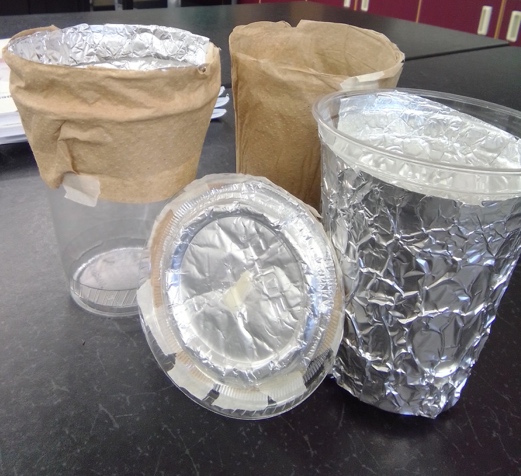
The success criteria for the rapid prototypes during the prototyping phase, when applying scientific principles, involved the correct arrangement of materials to manage conduction, convection, and radiation simultaneously. The minimal rise in temperature of the ice water over 40 minutes in a room at 72 Fahrenheit is no coincidence: it results directly from the applied science concepts.
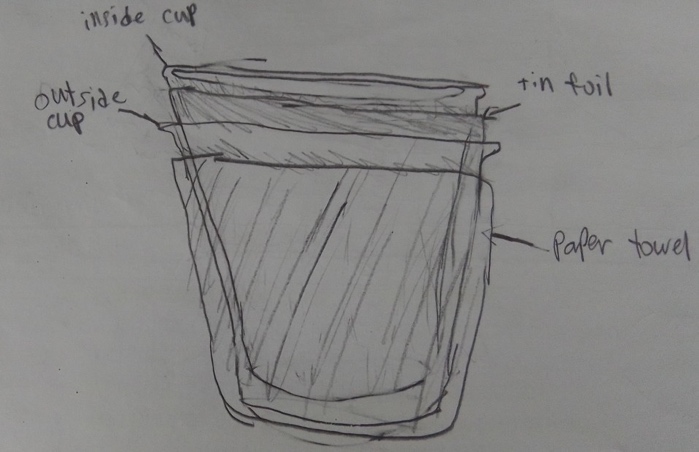
In Student A’s design sketch (see Figure 2), wrapping the paper towel over the foil of the inner cup indicates a misconception about radiation, since the foil would absorb energy from the paper towel. Placing a paper towel on the outer cup shows understanding of conduction. The nesting of the cups limits energy transfer between the inner and outer cups. However, there is not enough evidence to support the idea of convection, as the lid is missing.
Figure 2
Student-Developed Sketch of Design
After the rapid prototype task (see Figure 3), Student B used an angled, solid, dotted line to indicate that energy reflects off the foil, passes through the paper towel, and then enters the inner cup. The line segment entering the cup shows that conduction and convection are never zero, causing a temperature change.
Figure 3
Student Description of the Influence of Light, Foil, and Paper Towel on the Movement of Water Particles in the Prototype
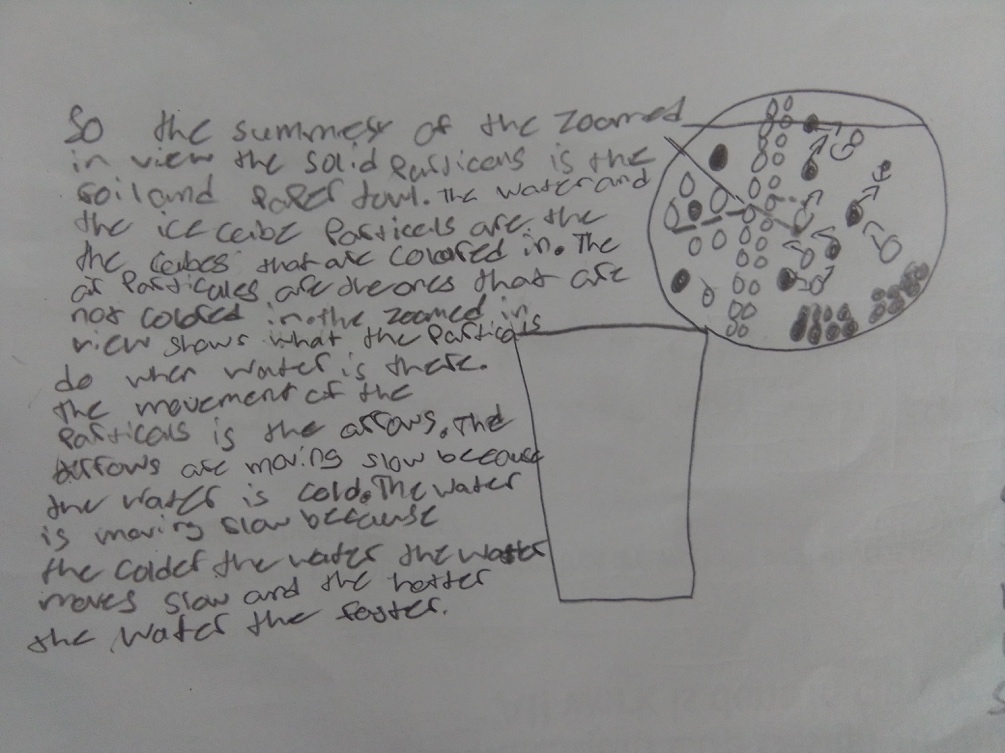
The students’ drawings depict different forms of energy that need to be included in the rapid prototype to ensure it works similarly to the benchmark model. For the rapid prototype to perform as effectively as the benchmark, intentional placement of materials based on their relationships to the materials’ properties and science concepts is necessary.
Teacher Recommendation
Teachers aiming to integrate reverse-engineering techniques into their current science curriculum must carefully assess the role of materials and the physical object, as the connection between the two influences the core disciplinary concepts. One potential approach is outlined in the Framework for P-12 Engineering Learning report. Grounded in recommendations from this report (Advancing Excellence in P-12 Engineering Education & American Society for Engineering Education, 2020), I created prompts to help teachers identify available materials that mimic the features of existing benchmark models (see Table 4). By aligning inexpensive materials with the benchmark model, students can focus on using them to express the scientific concepts needed to transform their ideas into a functional rapid prototype. The goal is to inspire teachers to see beyond rapid prototyping as merely building things and instead recognize it as a process requiring scientific and engineering knowledge to bring the intended design to life.
Table 4
Prompts for Evaluating Existing Benchmark Models to Identify the Best Low-Cost Materials for Rapid Prototyping
|
Prompts |
|
1. What are the materials used in the benchmark model? |
|
2. What is the purpose of the materials used in the benchmark model? |
|
3. How do these materials contribute to the effectiveness of the benchmark model? |
|
4. What is the price point of those materials? Is it feasible within my classroom context? |
|
5. If not feasible, which available materials closely match the intended benchmark model’s final material? |
|
6. How can the available materials guarantee that the rapid prototype exhibits behavior resembling the benchmark model? |
|
7. What limitations of the materials should I be mindful of? |
References
Advancing Excellence in P-12 Engineering Education & American Society for Engineering Education. (2020). Framework for P-12 engineering learning: A defined and cohesive educational foundation for P-12 engineering. American Society for Engineering Education. https://doi.org/10.18260/1-100-1153-1
Ladachart, L., Cholsin, J., Kwanpet, S., Teerapanpong, R., Dessi, A., Phuangsuwan, L., & Phothong, W. (2022). Using reverse engineering to enhance ninth-grade students’ understanding of thermal expansion. Journal of Science Education and Technology, 31, 177–190. https://doi.org/10.1007/s10956-021-09940-1
Malkiewich, L.J., & Chase, C.C. (2019). What’s your goal? The importance of shaping the goals of engineering tasks to focus learners on the underlying science. Instructional Science, 47, 551–588. https://doi.org/10.1007/s11251-019-09493-2
Mohan, L., Buck Bracey, Z., Harris, E., Jamshidi, A., Lo, A., Novak, M., Ramirez, T., Novak, D., Scaletta, T., Van Horne, K., & Fortus, D. (2022). Thermal energy: How can containers keep stuff from warming up or cooling down? OpenSciEd. https://openscied-uploads-production.s3.amazonaws.com/G6_UTH/lowres/6.2%20Teacher%20Edition.pdf
National Academies of Sciences, Engineering, and Medicine. (2020). Building capacity for teaching engineering in K-12 education. The National Academies Press. https://doi.org/10.17226/25612
Purzer, Ş., Quintana-Cifuentes, J., & Menekse, M. (2022). The honeycomb of engineering framework: Philosophy of engineering guiding precollege engineering education. Journal of Engineering Education, 111(1), 19–39. https://doi.org/10.1002/jee.20441
Rising, H. (2025). How to make a thermos. wikiHow. https://www.wikihow.com/Make-a-Thermos
Sarkar, N. (2022, December 8). Vacuum flask thermo flask [digital diagram]. Shutterstock.com. https://www.shutterstock.com/image-vector/vacuum-flask-thermo-fully-diagram-cross-2236060447
Zhong, B., Liu, X., & Li, X. (2024). Effects of reverse engineering pedagogy on students’ learning performance in STEM education: The bridge-design project as an example. Heliyon, 10(2), e24278. https://doi.org/10.1016/j.heliyon.2024.e24278
Photo by Viktor Talashuk on Unsplash